
0 gram, 100 gram, liner, neck, rain sheet or stable blanket? The blanket jungle can feel bigger than ever. Here we help you understand the differences – and choose the right blanket for your horse, season, and everyday life.
As late summer turns to autumn, the same questions return in the stable.
- Does the horse need a blanket tonight?
- Is 100 grams too warm?
- What is really the difference between a rain sheet and a turnout blanket?
- Do I need a neck cover?
- And what do 600D, 1200D, and 1680D mean?
It's easy to get stuck in numbers.
But the most important thing when choosing a horse blanket is not to find the one with the most features.
It's to understand what problem the blanket should solve.
- Should the horse stay dry in late summer rain?
- Does a clipped horse need extra warmth?
- Should the blanket withstand many hours in the paddock?
- Do you need a flexible system where the lining can change during the season?
When you know that, the blanket jungle becomes much simpler.
Here we guide you through the most common types of horse blankets – and what to consider before choosing.
Start here: what need should the blanket solve?
There are three main functions of most horse blankets:
- Protect against weather.
Especially rain and wind. - Provide warmth.
Through different amounts of filling. - Help the horse dry.
After training, transport, or washing.
A blanket doesn't need to be warm to be useful.
A 0-gram rain sheet and a 300-gram winter blanket can both be perfect – but in completely different situations.
0 grams – when you want to keep the horse dry without extra warmth
A 0-gram turnout blanket has no or minimal insulating lining.
That's why it's often one of the most useful blankets in autumn.
A 0g blanket is often suitable when:
- It's raining but the temperature is still relatively mild.
- The horse needs protection from wind and precipitation.
- You want to keep the horse dry before riding.
- The horse has its own coat and doesn't need extra insulation.
- You want to use a liner system and add warmth later.
For many horses, 0 grams is the perfect starting point in late summer and early autumn.
Instead of automatically adding warmth, you protect the horse from the weather and can then adjust according to the temperature.
Product type to look for
Choose a real turnout blanket that is:
- Waterproof.
- Breathable.
- Durable enough for your horse's paddock environment.
- Properly cut for the horse's body shape.

0-gram turnout blanket
The perfect blanket
When you want to keep the horse dry without extra warmth. A 0-gram turnout blanket has no or minimal insulating lining. That's why it's often one of the most useful blankets.


50–100 grams – the perfect transition blanket?
Here we start adding some warmth without going directly to a real winter blanket.
For many clipped or slightly colder horses, a lightly padded blanket is very useful during autumn and spring.
50–100 grams often suits:
- During cooler autumn nights.
- For lightly clipped horses.
- In rain and wind when 0 grams feels too little.
- As a transition between rain blanket and winter blanket.
- For horses that easily get cold but do not need heavy insulation.
This is often an underestimated category.
Instead of going from 0 grams directly to 200 grams, a lightly padded blanket can provide significantly more options to adapt to the weather.
Our recommendation
If you have a horse that is regularly used, clipped in the autumn, and spends many hours outside, a good 0-gram blanket and a lightly padded blanket are often a very useful base.

50 - 100-gram outdoor blanket
The perfect transition blanket?
Here we start adding some warmth without going directly to a real winter blanket. For many clipped or slightly colder horses, a lightly padded blanket is very useful during autumn and spring.


150–200 grams – when autumn becomes winter
When the temperature drops further, we enter the mid-weight blankets.
150–200 grams provide clearer insulation and are often used on clipped horses during colder periods.
Mid-weight blankets are often suitable for:
- Clipped horses in late autumn.
- Milder winter days.
- Horses that are outside for large parts of the day.
- When the weather fluctuates between a few degrees above and below zero.
But it's important not to just look at the temperature.
Wind, precipitation, access to shelter, body condition, clipping, and individual sensitivity affect how much warmth the horse actually needs.

150 - 200-gram turnout rug
when autumn becomes winter
Wind, precipitation, access to shelter, body condition, clipping, and individual sensitivity affect how much warmth the horse actually needs.


250–400 grams – the winter blanket for the coldest periods
Here we talk about clearly warm blankets.
They are mainly used when the temperature drops significantly and for horses that have a greater need for extra insulation.
A heavier winter blanket may suit:
- Fully clipped horses.
- Older or thin horses.
- Horses that have difficulty keeping warm.
- During longer cold periods.
- In combination with a lot of wind and precipitation.
However, this does not mean that 300 or 400 grams are automatically needed just because the thermometer shows below zero.
An unclipped horse in good condition, with access to roughage and shelter, has completely different conditions than a fully clipped competition horse.
Choose grams according to the horse – not just according to the weather app.
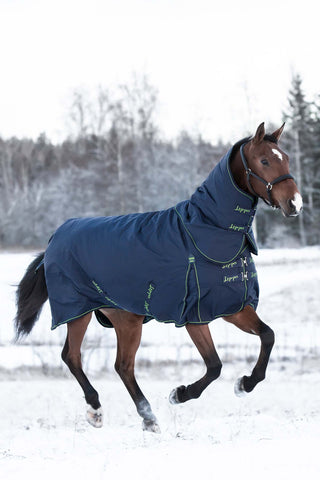
250 - 400-gram outdoor blankets
winter blankets
Here we talk about clearly warm blankets. They are mainly used when the temperature drops significantly and for horses that have a greater need for extra insulation.


Rain sheet or turnout blanket – what is the difference?
The terms are sometimes used almost as synonyms.
A rain sheet is usually an unlined or lightly lined waterproof turnout blanket.
A turnout blanket is the broader category and can range from 0 grams to heavily lined winter models.
When shopping, you should therefore look less at the product name and more at:
- Is the blanket waterproof?
- How much filling does it have?
- What outer fabric is used?
- Is it made for long-term outdoor use?
- How is the fit?
What do 600D, 1200D, and 1680D mean?
This is one of the most common questions about blankets.
D stands for denier and describes in simplified form the thickness of the fibers in the outer fabric.
Generally:
600D: lighter outer fabric. Often suitable for calmer horses and paddocks where wear is limited.
900–1000D: a good middle ground for many horses.
1200D: heavier and more durable. Good for extensive outdoor use and more demanding paddock environments.
1680D and above: very robust outer fabrics for horses or environments where durability is highly prioritized.
But a higher denier count is not automatically a better blanket.
Construction, material quality, weaving, and seams also play a significant role.
Choose according to your horse
If you have a horse that never destroys blankets, you may not need the market's heaviest outer fabric.
However, if you have a horse that plays hard in the paddock or goes in a herd, durability might be an important investment.

flexible solution
Liner system
For a clipped horse that is ridden regularly and where the blanket needs change a lot between October and March, the system can be particularly practical.


Liner system – smart for the Swedish weather
A product solution we find particularly useful in our climate is blankets that can be complemented with liners.
The basic idea is simple.
You have a waterproof outer blanket and then add, for example:
- 50 grams.
- 100 grams.
- 200 grams.
- 300 grams.
depending on the weather and the horse's needs.
This means that one and the same outer blanket can be used through a large part of the season.
Advantages of liners
- Fewer complete blankets are needed.
- Easier to adapt to the weather.
- The liner is often easier to wash and dry.
- You can change the warmth without changing the entire outer blanket.
Horseware's liner system is a clear example of this and suits riders who want to build a flexible blanket wardrobe instead of buying a separate outdoor blanket for each temperature.
When the liner system is extra smart
For a clipped horse that is ridden regularly and where the blanket needs change a lot between October and March, the system can be particularly practical.

the blanket with that little extra
Stable blankets
The stable blanket is made for a drier environment and usually lacks the same weather protection as an outdoor blanket. It is mainly used to provide warmth in the stable.


Stable blanket – when do you need it?
The stable blanket is designed for a drier environment and usually lacks the same weather protection as an outdoor blanket.
It is mainly used to provide warmth in the stable.
Stable blanket is suitable for:
- Clipped horses in cold stables.
- As a night blanket.
- During transport in cold weather.
- As part of a layering system.
Important:
Do not use a regular stable blanket outside in the rain.
It is not designed to withstand precipitation like an outdoor blanket.
With or without neck?
Neck pieces are available both fixed and detachable.
Which is best depends again on the horse and the need.
Neck can be useful when:
- The horse is fully clipped.
- There is a lot of rain and wind.
- You want to keep the neck clean and dry.
- The horse is outside for long periods in exposed weather.
Without neck can be better when:
- The horse easily gets warm.
- You want maximum ventilation.
- The horse is not clipped over the neck.
- The weather is milder.
A detachable neck system often provides the greatest flexibility.
Then the same blanket can be used in several different ways during the season.

the blanket with that little extra
Stable blankets
The stable blanket is designed for a drier environment and usually lacks the same weather protection as an outdoor blanket. It is mainly used to provide warmth in the stable.


Sweat Rug – after training, the horse needs something completely different
After training, the goal is not primarily warmth.
The goal is to remove moisture.
A sweaty horse needs to dry without getting cold.
Therefore, sweat and cooler rugs work with materials that transport moisture away from the horse's body.
Here are examples:
- Fleece rugs.
- Wool rugs.
- Mesh material.
- Technical spacer materials.
- Quick-drying functional materials.
Kentucky Horsewear 3D Spacer Cooler and Horseware's cooler rugs are examples of more technical solutions focusing on moisture transport and ventilation.
Choose a sweat rug based on use
For everyday training, a light quick-drying rug may suffice.
For competition, transport, and winter training, a more technical or warming option may be relevant.

The Fit – Perhaps More Important Than All the Numbers
It's easy to compare grams and denier.
But the blanket must first and foremost fit the horse.
Check especially:
- The Shoulder:
The blanket should allow freedom of movement without sliding back or causing chafing. - The Withers:
The blanket should not create constant pressure. - The Neck Opening:
A too large opening can cause the blanket to slide back. Too small can create pressure. - The Length:
The blanket should cover the body properly without being oversized. - The Girths:
They should allow freedom of movement but not hang so low that the horse risks getting caught.
Different Brands Fit Differently
This is important.
A horse that fits perfectly in Horseware does not automatically fit as well in Kentucky Horsewear or another brand.
Just like with riding helmets, much depends on body shape.
It is therefore often smarter to find which cut fits the horse than to just choose based on design or price.
How to Build a Smart Blanket Wardrobe
You don't necessarily need ten different blankets.
For many horses, a well-thought-out base can be more useful.
For the Unclipped Horse
A simple wardrobe can, for example, consist of:
- A good 0g rain blanket.
- A lightly lined outdoor blanket if needed.
- A sweat blanket.
For the Clipped Hobby Horse
A flexible base can be:
- 0g outdoor blanket.
- 100g outdoor blanket or liner.
- 200g blanket or liner.
- Warmer options for cold periods.
- Sweat blanket.
For the Fully Clipped Competition Horse
Here, a liner system can be particularly smart:
- Durable 0g outer blanket.
- 100g liner.
- 200g liner.
- 300g liner.
- Detachable neck.
- Stable blanket.
- Technical sweat blanket.
Then you can build warmth as needed instead of having a separate outer blanket for each weather.
Quick Guide – Which Blanket Should I Choose?
- Mild + Rain:
0g waterproof rain or outdoor blanket. - Chilly Autumn + Clipped Horse:
50–100g outdoor blanket. - Late Autumn / Mild Winter:
150–200g depending on the individual. - Cold + Fully Clipped Horse:
250–400g may be relevant depending on conditions. - Fluctuating Temperature:
0g outer blanket + liner system. - After Riding:
Sweat or cooler blanket. - In the Stable:
Stable blanket when extra warmth is needed. - Heavy Rain and Wind:
Prioritize waterproofing, fit, and neck if needed.
Other Options
Svensk Ridsport also has blankets from other brands and various price ranges.
Therefore, rather start from:
- The horse's body shape.
- The need.
- How much the blanket will be used.
- The paddock environment.
- The flexibility you need.
Then comes the brand.
The Most Important: Check the Horse, Not Just the Weather App
A blanket guide can help you choose.
But no table can feel your horse.
Therefore, regularly check under the blanket.
Feel behind the withers and over the body.
The horse should feel comfortably warm and dry – not hot and damp.
Also, remember that the need can change during the same day.
A chilly morning can be followed by a warm afternoon.
That's why we like flexible solutions: 0 grams, lighter fillings, detachable necks, and liners that make it easier to adjust according to conditions.
Still Unsure? Start with Three Questions
If the blanket jungle still feels big – start here:
1. Should the blanket protect against rain, provide warmth, or help the horse dry?
2. Is the horse clipped or unclipped?
3. How much time does the horse spend outside and how exposed is the paddock to wind and rain?
Once you have answered the three questions, you have already filtered out the majority of options.
And then the most important thing remains:
to find the model that fits your horse.
At Svensk Ridsport, you will find rain blankets, outdoor blankets, liners, stable blankets, and sweat blankets for different needs and seasons.
Not because every horse needs more blankets.
But because the right blanket at the right time can make a big difference.